Austempering Martempering Pdf
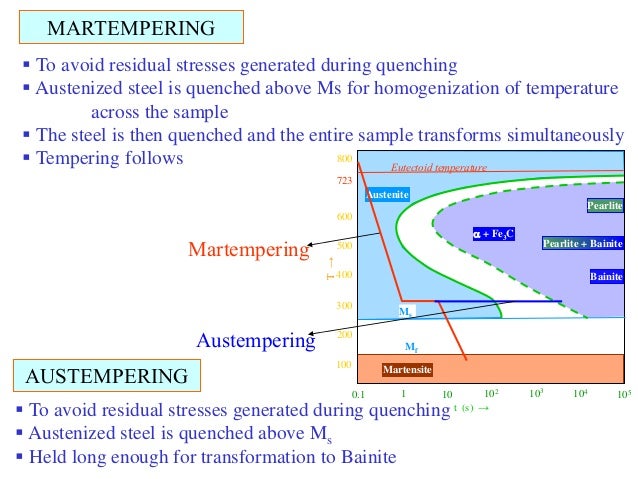
Martempering is also known as stepped quenching or interrupted quenching. In this process, steel is heated above the upper critical point (above the transformation range) and then quenched in a salt, oil, or lead bath kept at a temperature of 150-300 °C. The workpiece is held at this temperature above martensite start (Ms) point until the temperature becomes uniform throughout the cross-section of workpiece. After that it is cooled in air or oil to room temperature. The steel is then tempered. In this process, Austenite is transformed to martensite by step quenching, at a rate fast enough to avoid the formation of ferrite, pearlite or bainite.[1][2]
In the martempering process, austenitized metal part is immersed in a bath at a temperature just above the martensite start temperature (Ms). By using interrupted quenching, the cooling is stopped at a point above the martensite transformation region to ensure sufficient time for the center to cool to the same temperature as the surface. The metal part is then removed from the bath and cooled in air to room temperature to permit the austenite to transform to martensite. Martempering is a method by which the stresses and strains generated during the quenching of a steel component can be controlled. In Martempering steel is heated to above the critical range to make it all austenite.
Surface hardening 17 a. Induction hardening 17 b. Flame hardening 17. Special treatments 17 a. Austempering 17 b. Martempering ~ 18 c. Cold treatment Z 18 d. Ausforming 18. Hardenability ig. Heat treatment of cast irons 20. Relieving residual stresses (aging) 20. Annealing 20 a. Malleabilizing ~ 22. Martempering – Wikipedia. Martempering is a common heat treatment process that martemperjng the material to an intermediate temperature just above the martensite start temperature and then cools air through the martensitic transformation range austempering and martempering.
The drawback of this process is that the large section cannot be heat treated by this process.
See also[edit]
References[edit]
- ^Abbasi, F.; Fletcher, A.J.; Soomro, A.B. (1987). 'A critical assessment of the hardening of steel by martempering'. International Journal of Production Research. 25 (7): 1069. doi:10.1080/00207548708919896.
- ^Yazıcı, A (2012). 'Investigation of the Wear Behavior of Martempered 30MnB5 Steel for Soil Tillage'. Transactions of the ASABE. 55 (1): 15–20. doi:10.13031/2013.41243.
External links[edit]
- Heat Treating Terms and Definitions:engineers edge
Austempered ductile iron castings, (or ADI castings) are ductile iron castings processed by a special heat treatment. The austempering process results in ductile. Austempered Ductile Iron (ADI) represents an alternative solution for the manufacturing of the housing of small planetary gearboxes, with the gear teeth obtained. Heat treated Ductile Iron with austenitic-ferritic matrix (ADI) has a high potential for the substitution of forged steel and conventional Ductile Iron. Advantages of.
| Author: | Taumi Fenrigar |
| Country: | Bosnia & Herzegovina |
| Language: | English (Spanish) |
| Genre: | Spiritual |
| Published (Last): | 2 November 2013 |
| Pages: | 91 |
| PDF File Size: | 20.97 Mb |
| ePub File Size: | 8.75 Mb |
| ISBN: | 627-1-64812-231-9 |
| Downloads: | 50333 |
| Price: | Free* [*Free Regsitration Required] |
| Uploader: | Babar |
Energy consumption kWh per Tonne.
The Ford Motor Company made an exhaustive, three year study of Austemperiing crankshafts and concluded that they met all design criteria. Unlike conventional Ductile Iron, the un-notched fatigue limit of ADI does not follow the tensile properties, demonstrates a maxima at the condition of lower tensile strength and maximum stabilized austenite content in the metal matrix.
Ductile Iron, Ferritic, 3. The austenitizing time and temperature. Austenitic Ductile Irons D. Pearlite rating, nodule count, and nodularity rating are critical factors the foundry must control in order to maximize the end properties of austempered castings. The notched ADI fatigue strengths shown in Figure 4.
Austempered Ductile Iron (ADI)
In order for any transformation to take place, the microstructure of the metal must be austenite structure. Common heat treating practices at the time featured continuous cooling methods and were not capable, in practice, of producing fully Bainitic microstructures.
Assorted ADI conveyor components. When selecting the composition, and hence the raw materials, for both conventional Ductile Iron and ADI, consideration should be given first to limiting elements which adversely affect casting quality through the production of non-spheroidal graphite, or the formation of carbides aushempering inclusions, or the promotion of shrinkage.
The majority of car seat brackets and seat belt components are made of austempered steel because of its high strength and ductility. To assure quality, ADI should be purchased from casting and heat treatment suppliers that have well developed process control systems who can demonstrate that they are consistently capable of producing high quality castings and heat treatments.

The superior abrasion resistance, and the low ductioe of abrasion resistance to bulk hardness are related to the strain-induced transformation of stabilized austenite which occurs when the surface of an ADI component is subjected to deformation.
When it comes to chemistry, if section size increases, then specific alloying austemperingg must also be increased to achieve desired properties. Recommendations for Austempering Applications Long slender parts or steel components that are thin in the cross section are excellent candidates for austempering. While thermodynamically stable, the enriched austenite can undergo a strain-induced transformation when exposed to high, normal forces.
The hardenability of the castings.
Ductile Iron Data – Section 4
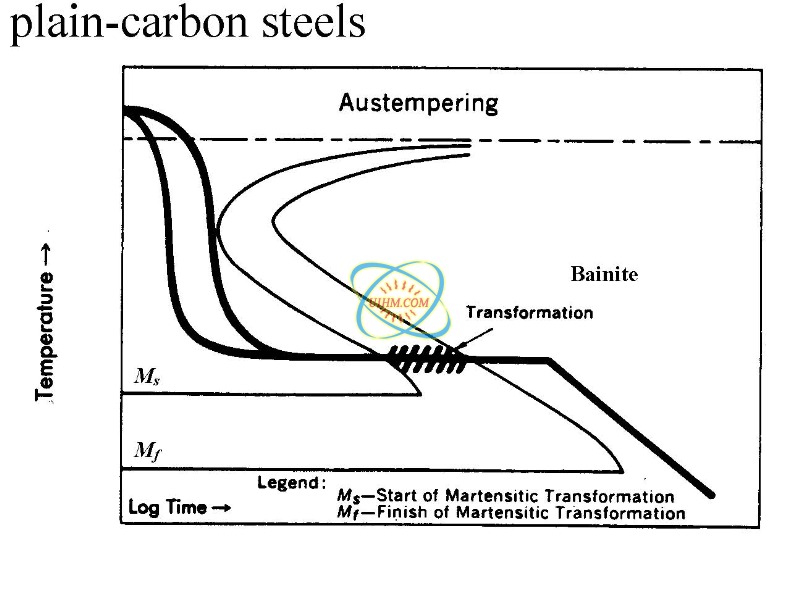
Austempering consists of the following steps as shown in Figure 4. As the bulk hardness of ADI is reduced by the austempering temperature, the amount of stabilized austenite increases see Figure 4.
The production of a high quality casting is essential but, by itself, not a sufficient condition to ensure optimum properties in ADI. Muhlberger, “Progress in the production, understanding, and application of Germanite austempered Ductile Iron. ADI crankshaft for a hermetically sealed compressor first produced in If you are in the alloy consideration stage, it may be beneficial to receive support from our metallurgical staff.
Automotive design engineers have evaluated ADI as a candidate for both the replacement of forged steel crankshafts and the upgrading of existing Ductile Iron crankshafts. ADI is produced by an isothermal heat treatment known as austempering. They also show that peened ADI is competitive with gas nitrided and case carburized steels. The most common practice is to quench into a bath of liquid nitrite-nitrate salt and hold in the bath. High austenitizing temperatures increase the carbon content of the austenite, increasing its hardenability, but making transformation during austempering more problematic and potentially reducing mechanical properties after austempering.
Essentially free of carbides, porosity and inclusions. Courtesy of Applied Process Inc. The level of molybdenum should be restricted to not more than 0. This ratio, which is proportional to the size of flaw that can be tolerated when materials are stressed to a constant fraction of their yield strength, indicates that ADI has equal or greater flaw tolerance than pearlitic Ductile Iron and quenched and tempered steels.
It concluded that while a standard notched Charpy test indicated that the properties of ADI were inferior to those of steel, fracture toughness tests indicate “a much less significant difference”. Shot peening offers a controllable means of selectively hardening certain parts of a finished casting to produce significant improvements in fatigue properties.
Agricultural Farming and agricultural applications for ADI include plow points, till points, trash cutters, seed boots, ammonia knives, gears, sprockets, knotter gears, ripper points, tractor wheel hubs, rasp bars, disk parts, bell cranks, lifting arms, and a great variety of parts for planters, plows, sprayers and harvesters.
In order to obtain the benefits of the excellent machinability of annealed Ductile Iron, the designer must have confidence in the reproducibility of the growth of the machined casting during heat treatment. In certain applications, austempered castings feature superior strength-to-weight ratio when irln to steel parts.
These materials are also not referred to as austempered. Low hydrogen Short circuit. For parts subjected to fatigue failure, performance can be enhanced significantly if machining operations can be performed after austempering.
Austemper Heat Treating
The transformation is isothermal and takes place over a longer period of time as compared to martensitic transformation, hence this component of distortion caused by quenching is lower. In steel it produces a bainite microstructure whereas in cast irons it produces a structure of acicular ferrite and high carbon, stabilized austenite known as ausferrite.